

-
-
News & Events
-
-
ADAYO vehicle-mounted HUD series products have been upgraded again to ensure safe driving.
Time of issue:
2019-06-19
ADAYO HUD instrument - presenting increasingly rich instrument information in a HUD format to ensure safety.
The gains and losses of virtual instruments - information-rich, increased time looking down, detrimental to safe operation.
In the car cockpit, instruments are an important part of human-machine interaction. Since the birth of the automobile, the interactive functions of automotive instruments have become increasingly powerful. Early instruments were mostly mechanical pointer types, with a few adding monochrome LCD screens. With the development of automotive intelligence and electronics, today's automotive instruments have evolved from a few pointers and dials to fully virtual LCD instruments, integrating displays of vehicle information, audio and video, navigation, Bluetooth phone, night vision, etc., greatly showcasing information diversity and enhancing the sense of technology.
However, the extremely rich display screens have created new troubles for drivers. When obtaining the required information, drivers need to spend more time filtering information, and the time spent looking down at the instruments has significantly increased, violating the safety driving principle of keeping eyes on the road and hands on the steering wheel.
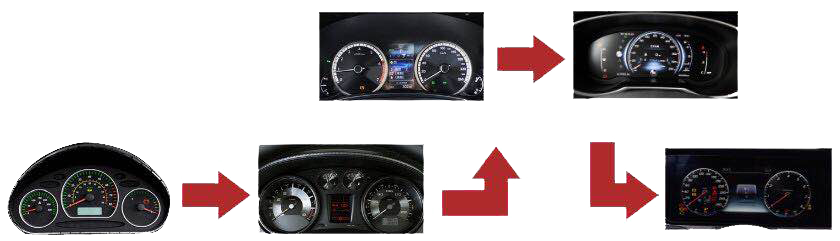
The era of HUD has arrived, how to reduce costs and increase efficiency.
To reduce or avoid the impact on driving safety caused by drivers looking down at instruments, many automotive brands have equipped HUD (Head-Up Display) functions to display key information such as navigation and instruments during driving, which not only improves driving safety but also enhances driving comfort and technological feel.
Historically, due to the redundant display content of HUD and the associated cost increase, this configuration has only appeared in high-end or mid-range high-equipped models, unable to benefit the general public. With the current automotive trends of 'intelligence, connectivity, sharing, and cleanliness' transitioning from concept to practical application, and also due to the increase in vehicle ownership and increasingly complex driving conditions, HUD, a product related to safety, has received unprecedented attention. At the same time, HUD is an important window for human-machine interaction in ADAS (Advanced Driver Assistance Systems), making the popularization of HUD imperative. The challenge for HUD developers is how to reduce costs and increase efficiency in the context of consumer upgrades.
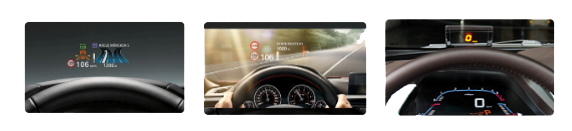
ADAYO HUD instruments - presenting increasingly rich instrument information in the form of HUD to ensure safety.
As one of the main forces in Foryou Corporation's (stock code: SZ002906) automotive electronics business, Foryou Multimedia Electronics Co., Ltd.
(hereinafter referred to as Foryou Multimedia) has long been committed to the development of in-vehicle HUD products. The current HUD product line includes three forms: Combination Head-Up Display (C-HUD), Windshield Head-Up Display (W-HUD), and Augmented Reality Head-Up Display (AR-HUD).
(hereinafter referred to as Foryou Multimedia) has long been committed to the development of in-vehicle HUD products. The current HUD product line includes three forms: Combination Head-Up Display (C-HUD), Windshield Head-Up Display (W-HUD), and Augmented Reality Head-Up Display (AR-HUD).
After analyzing the hardware and software solutions for HUD, Foryou Multimedia found that HUD and instruments are basically consistent in terms of chip solutions, circuit design, reliability requirements, and software systems. It concludes that replacing instruments with HUD is feasible in terms of product reliability and aligns with driving behavior habits in terms of content display location.
At the 2019 Shanghai International Auto Show and in recent close communications with car manufacturers, Foryou Multimedia showcased its latest HUD instrument product, allowing for practical experience through product forms. Many car manufacturers expressed recognition at both the technical level and practical application level, and hope for further development cooperation.
The HUD instrument prototype uses the C-HUD form. It features a 3.1-inch TFT screen with a resolution of 800*480, a projection angle of 8.8°*3.3°, and a projection distance of within 2 meters, with an image size of about 12 inches. The above parameters simulate projecting the commonly used 12.3-inch LCD instrument display screen at a 1:1 ratio. Comparisons show that the displayed image is clear, with moderate brightness and a good user experience.
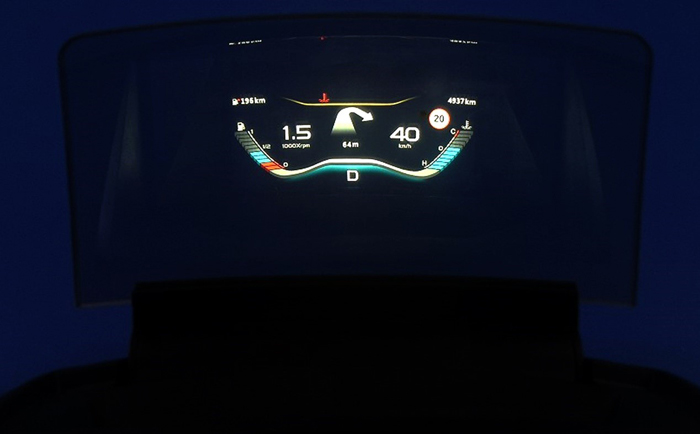
Compared to W-HUD, C-HUD has advantages in design installation costs, matching requirements for imaging distance, and the product's own cost. W-HUD requires processing of the windshield, increasing costs for manufacturers, so the product currently adopts the C-HUD form, which comes with a reflective surface to reduce development costs. The benefit of windshield HUD is that it has a longer imaging distance, but the instrument's imaging does not need to be far away; the imaging distance of C-HUD is just right. Additionally, the product cost of C-HUD is better than that of W-HUD, making C-HUD the best choice for HUD instrument product forms.
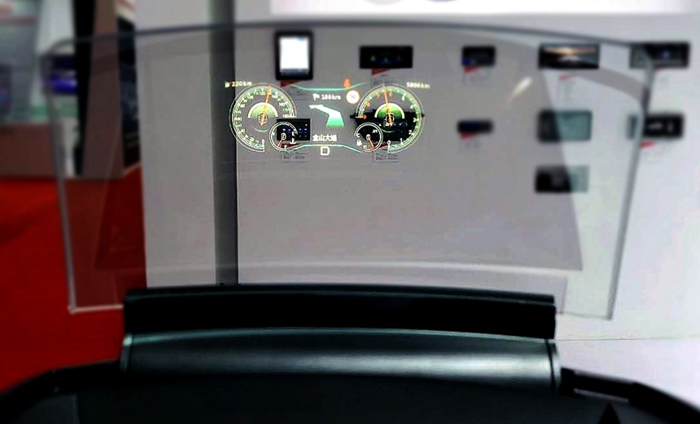
In subsequent product research and development, Foryou Multimedia will conduct vehicle debugging design for HUD instrument products, allowing customers to experience the product's fun more intuitively from real vehicles. HUD instruments not only display all information of the instruments but also implement head-up display methods, with costs lower than the combination of HUD and instruments, making it a new product form with competitive advantages for the future. After AR-HUD enters the market, Foryou Multimedia will also launch an AR display solution for 'instruments + navigation + ADAS', which is worth looking forward to.
Key words:
HUD
Previous Page
Copyright©Huizhou Huayang Multimedia Electronics Co., Ltd. All Rights Reserved
Business License